

I will start this post with an apology. For once in my life, I overestimated the planning that goes into the reliability of the physical grid.
I apologize to my readers. I plan to return to my cynical self. I am fully aware that nobody in an RTO grid is responsible for reliability. I will not make this mistake again.
What I said
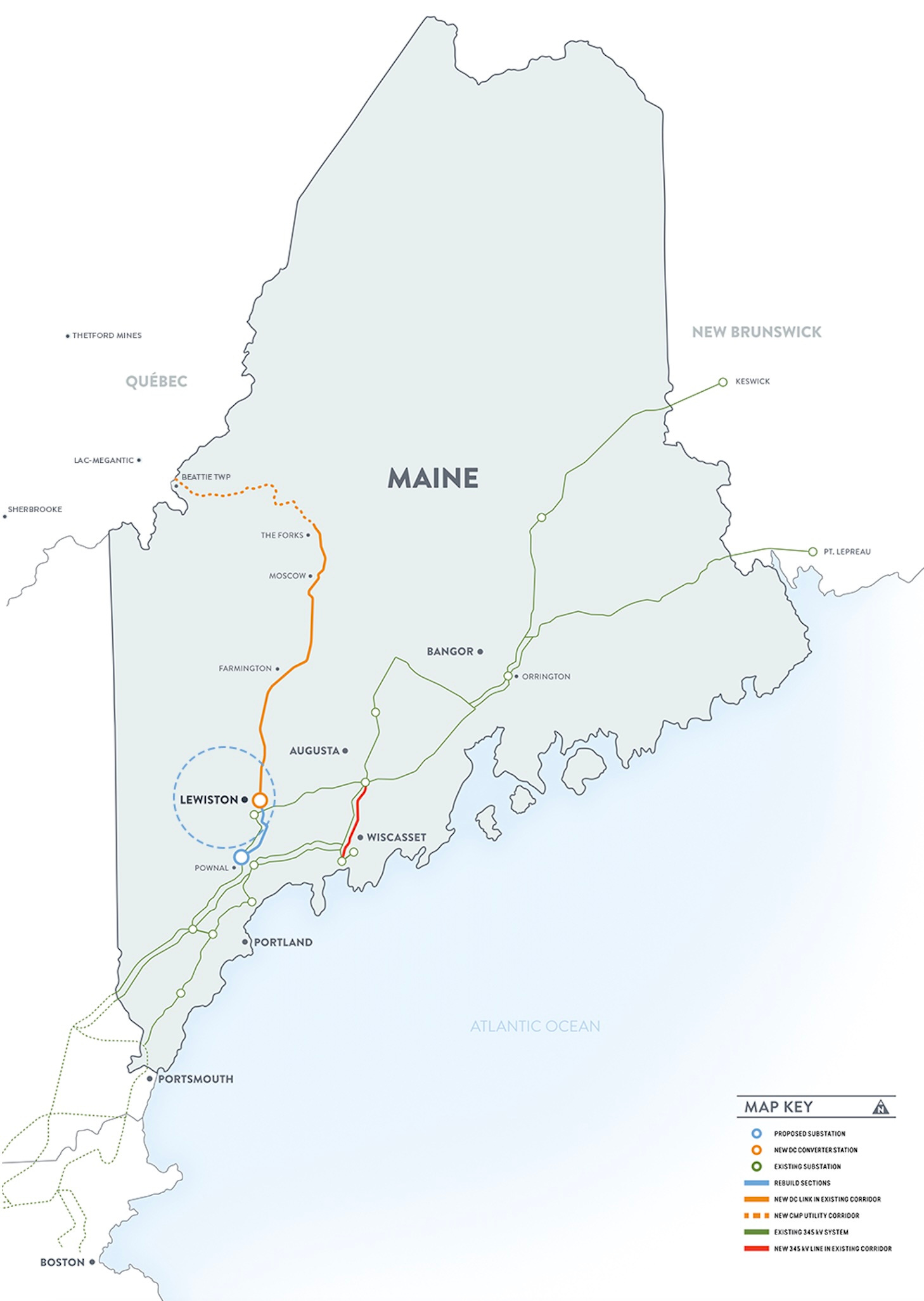
In my recent post, A Tale of Two Transmission Lines, I wrote about the NECEC transmission lines to Maine. (NECEC is New England Clean Energy Connect, It brings power from Québec to Maine.)
“The entire area (Québec, Maine and further into New England) had been hit by very cold temperatures. ….. During the cold snap, Québec stopped sending power to Maine. The outage lasted slightly less than two days.
The possibility of a short interruption was clearly something that the NECEC and HQ knew might happen. HQ will have to pay a fine to its American partners. Probably, such fines were arranged in advance, in the agreement between HQ and the NECEC.”
Was I right?
I was right, AND I was wrong.
Plans were indeed in place. One of the best resources about NECEC is an August blog post from Joe LaRusso at the Acadia Center in Maine. NECEC’s First Six Months, An Assessment. As LaRusso wrote:
“HQUS’s voluntary decision in January to cease flowing hydropower via NECEC to serve domestic provincial load triggered an uncured delivery shortfall: HQUS was required to pay cover damages equal to the incremental cost that National Grid, Eversource, and Unitil incurred replacing and delivering the energy HQUS chose to reserve for its own domestic customers, together with the cost of replacement environmental attributes for each MWh delivery missed….. the combined cost during ….Winter Storm Fern reached as high as $1,200/MWh.9 That HQUS voluntarily took on that costly repayment obligation speaks to how acute HQUS’s need had been to serve its own provincial customers. “
My conclusion from this quote was that HQ had made a bargain, and it lived up to the bargain.
Maybe.
Was I wrong?
The lawsuits have begun.
In mid-September, Sarah Shemkus at Canary Media wrote: Mass. utilities and Hydro-Québec sue each other over missing hydropower.
According to Shemkus’s article, Massachusetts utilities say that “HQ should have been prepared for this situation: that Canada might get very cold in the winter was ‘entirely foreseeable.’”
In response, HQ argued that the extreme cold caused the grid operator (not HQ itself) to decide not to send power south. HQ did not make the decision to keep power at home, and therefore, it does not owe money to the Massachusetts utilities. Not sending power was “force majeure” due to extreme cold.
But Massachusetts utilities withheld money for the power they didn’t receive. HQ is suing for the withheld money.
HQ says that their contract allows them to make up that power at a different time. They claim that the Massachusetts utilities are taking the law into their own hands by withholding money.
But the Massachusetts utilities claim that HQ owes them $40 million dollars. Meanwhile, HQ has sued the utilities for $50 million.
(Whatever happens, I believe that all the lawyers will get paid.)
Curable or Force Majeure
Force Majeure simply means “it was not in our control.” It means that you cannot be held responsible for whatever happened. You can invoke Force Majeure for a meteor landing on your business or for an unpredicted action by a regulator.
Curable and Non-Curable are more complex. The LaRusso article lists curable and non-curable interruptions that have occurred on the NECEC line. As you might expect: curable means that you can correct the problem and non-curable means you can’t correct it. These terms usually refer to restitution (such as repairing a window that you broke) or payments.
I am not a lawyer, so I won’t go further with the question “under what circumstances can cold weather be considered force majeure.” Instead, I will end with a quote.
Canary Media quotes Caitlin Peale Sloan, vice president for climate and energy at the Conservation Law Foundation. “ ‘There’s lots coming out of this lawsuit that will help determine what protections should be enshrined in any future Canadian supply contracts,’ she said.”
In other words, these lawsuits for forty or fifty million dollars are just the opening guns in this conflict.
HQUS is the part of Hydro-Québec that works with the US utilities.
Force Majeure used to mean "act of God"; but now it seems more an act by the other party.
It sounds contributory. Every January for the past 4 years HQ has faced a supply cliff. It's been telling everybody and his brother NOT to establish new business in Quebec with a load exceeding 5 MW. Quebec in the last 4 years has supplanted New York and Michigan as Ontario's biggest electricity export destination, by far.
None of this should be a mystery to NE utilities and those planning (or as you say "planning") for the supply that energizes them.
Quebec decided to develop a side gig selling surplus power to NE. NE decided it could avoid the bother of developing its own supply by just buying from Quebec. Every winter it gets cold, and Quebec heats with electricity. Electrical load for heating is as variable as outdoor temperature -- it's a giant ferocious unpredictable grizzly bear of load that sits on top of "normal," i.e. non-heating, load, and warps and mangles it into something nobody recognizes.
I won't even mention Gentilly II or Vermont Yankee, or the anti nukes who put "you" -- Quebeckers and New Englanders -- into this position.