
Starting Small
Reviews of two recent books

I haven’t been posting much recently. Energy events are moving fast, and my own move to New Jersey is taking up much of my time. For twenty years in Vermont, George and I gradually set up a situation that was good for us. Friends, household arrangements, favorite restaurants, groups we belonged to, doctors and dentists, Osher classes we took, and Osher classes we gave.
Now we are starting over in New Jersey. And it all feels uphill.
I am beginning to write again. I’m starting small. I plan two posts that are simply some book reviews.
Eventually, I may get around to reviewing the latest proposals for RTO capacity auctions. I can delay the auction reviews because I would just have to write them again later if I write them now. Capacity auctions aren’t just a moving target: they are a target that is jinking around, doing evasive maneuvers.
On to the book reviews.
Books and Authors
Today’s first book is Rad Future: The Untold Story of Nuclear Electricity and How It Will Save the World by Isabelle Boemeke, published August 12, 2025 by Thesis. The second book is Atomic Dreams: The New Nuclear Evangelists and the Fight for the Future of Energy by Rebecca Tuhus-Dubrow. It was published on April 8, 2025 by Algonquin Books.
Rad Future is basically about nuclear technology and the uses of nuclear energy. It contains facts about how nuclear energy is produced and ideas about how it can fit into the world of the future. In contrast, Atomic Dreams is a history of the pro-nuclear movement. The author tries to understand the odd fact that some people are pro-nuclear. The book’s anti-nuclear stance is somewhat moderated over the course of the book.
Both books have extensive footnotes. As befits a technology book, Rad Future has many graphics and a glossary. Atomic Dreams has neither.
Rad Future
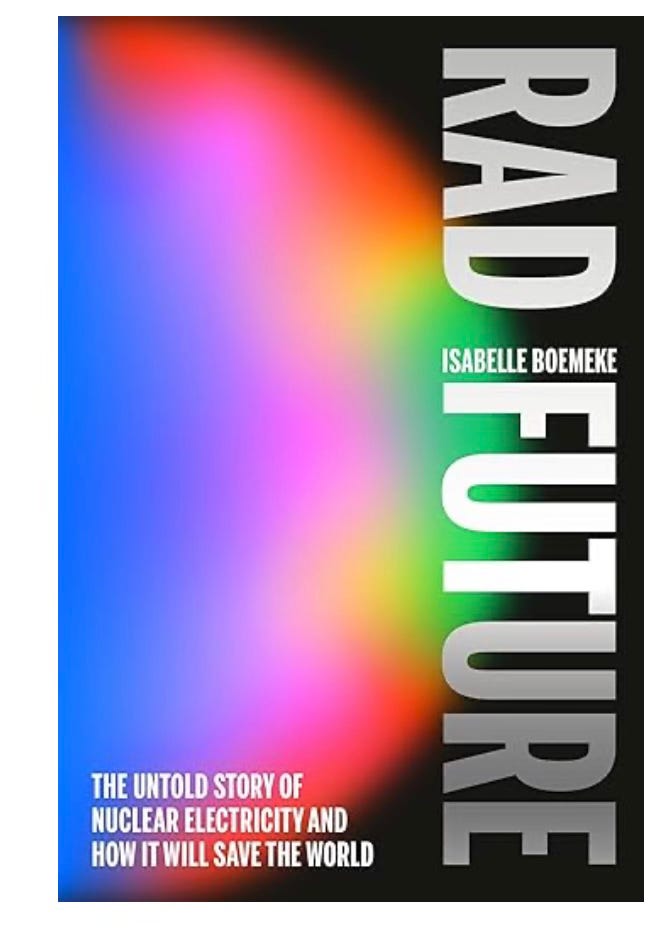
Rad Future’s author, Isabel Boemeke, is a model and TikTok influencer. She has given a TED talk, made many pro-nuclear videos, spoken to many groups, and is frequently interviewed. This video starts with a short description of her usual workout. (Yes, she is totally gorgeous, fit, and beautiful.)
Next, she describes her after-work-out snack: a few gummy bears. As she says, a gummy bear is the same size as a fuel pellet in a light water reactor. Nobody would confuse a railroad hopper car full of coal with a uranium pellet the size of a gummy bear. This is a great way to explain that nuclear energy is powerful and compact. It is also a memorable and amusing way to end a TikTok video.
In the book Rad Future, Boemeke includes many simple graphics that aid understanding. She also looks at national strategies: how Germany didn’t build a low-carbon grid, and how Ontario did build one. At the end of every section, she has a one-page summary with the heading TL;DR. “Too Long; Didn’t Read.” The book has a clear, concise modern vibe. It is a serious book with great references and a glossary.
I suspect that Boemeke was afraid of being considered merely a pretty face (a model). Perhaps she worried that people would think that she has no right to pen a serious book. In response, she clearly worked hard on this book. Rad Future is an excellent and readable introductory book.
Boemeke had every right to write a serious book. I encourage you to read it.
Atomic Dreams
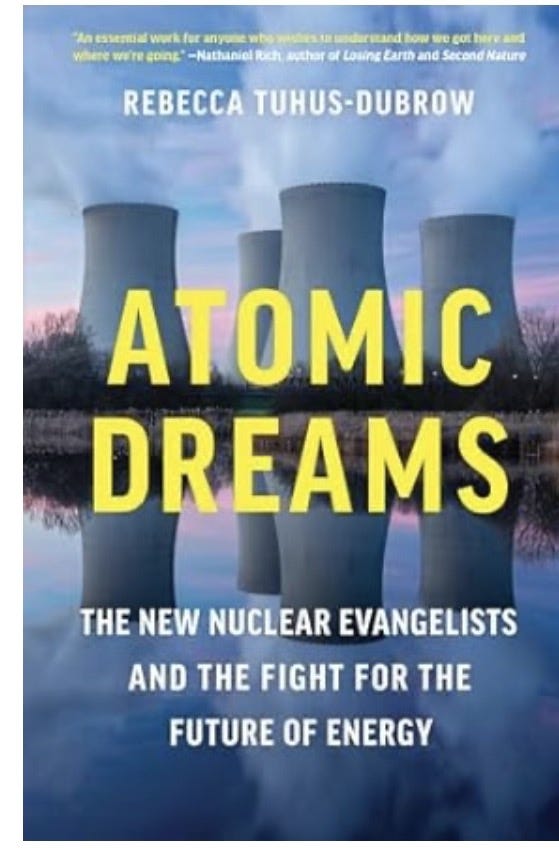
In contrast, nobody would accuse Rebecca Tuhus-Dubrow of not having a right to pen a serious book like Atomic Dreams. Ms. Tuhus-Dubrow is a widely published author, with credits at places like The Guardian and the New York Times Book Review. Atomic Dreams is a history of the pro-nuclear movement. The book describes who did what, and when and why they did it. It has a strong tinge of gossip.
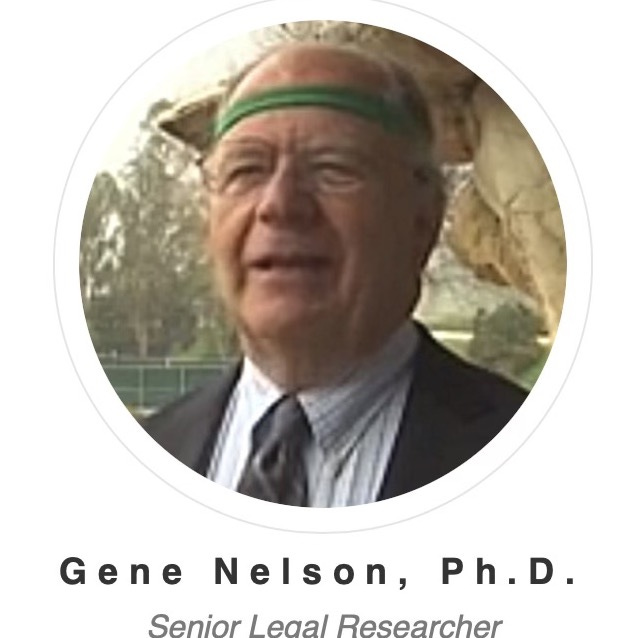
Atomic Dreams is the story of a movement, not a technology. Among other things, this means that Atomic Dreams has no graphics or glossary. However, like Rad Future, it is well-researched and has many footnotes. There are clear descriptions of some of the more memorable pro-nuclear people. For example, there’s a great section about Gene Nelson of California. He is one of the founders of Californians for Green Nuclear Power.
Tuhus-Dubrow’s book begins with a deeply anti-nuclear attitude. (Painful for me to read.) She finds it hard to believe that there are pro-nuclear women who love the natural world. Her writing displays her cognitive dissonance. How can anyone be pro-nuclear and an environmentalist? Gradually, she changes her mind somewhat. Her documentation of this change will be helpful for others who are struggling with the idea of becoming pro-nuclear.
Tuhus-Dubrow divides the pro-nuclear world into various sections, including:
o Nuclearists. They are pro-clean energy, and reluctantly okay with renewables plus nuclear
o Progressives who tolerate nuclear for what it can do.
She acknowledges herself as a Progressive.
She admits that the nuclear technology that scared her (and her family) in the old days might be exactly the technology that we need right now. However, the book does not finish with a ringing endorsement for nuclear. Pro-nuclear people are described as rather an odd group. Even if they are mothers who love the outdoors, there’s still something a little odd about them.
For example, here is Tuhus-Dubrow’s explanation about her term “nuclearists.”
“But the term [nuclear bros] was both gendered and implied an abrasiveness that did not apply to all strongly pro-nuclear advocates….I began to think of the more extreme version of pro-nuclear sentiment as ‘nuclearism’...as a gender-neutral alternatives to ‘nuclear bro.’ Eric Meyer was a nuclearist, and the Mothers [for nuclear] were nuclearists. They were not at all culturally bro-ish; they were not Twitter trolls; they generally stayed positive and personable. They simply put nuclear energy at the center of their vision of a better world.”
I believe this kind of thing is usually called “damning with faint praise.” In contrast, Tuhus-Dubrow has direct admiration for Jessica Lovering, co-founder of The Good Energy Collective. Lovering is a nuclear progressive. As Tuhus-Dubrow writes: the “Good Energy Collective advanced the concept of ‘nuclear justice’ which included bolstering diversity in the workplace, honoring community needs in future nuclear development, and redressing past harms.”
In other words, Tuhus-Dubrow likes nuclear when it fits with the progressive movement.
Stay Tuned
Both books are worthy additions to the nuclear literature. One is helpful for people who want to learn more about the technology, and one describes the history of the pro-nuclear movement. They have different slants and may appeal to different audiences.
Neither of these books mention my own two pro-nuclear books: Voices for Vermont Yankee and Campaigning for Clear Air, Strategies for Pro-Nuclear Advocacy. I will review my own books in a later post. (Overall, I will share four book reviews. Two are in this post and two more will be in a later post.)
Should be interesting watching NE ISO this winter from PJM. (And a little warmer!)
Thanks for these reviews. Interesting how the ideas around nuclear are changing.
We think about your efforts to save VT Yankee, and what the outcome might have been had it been at the present time.
Welcome back. We missed you.
Great reviews and insights.
good luck in new Jersey!