Cold. It has been cold. Below zero in some parts of New England, and down in the single digits in other parts.
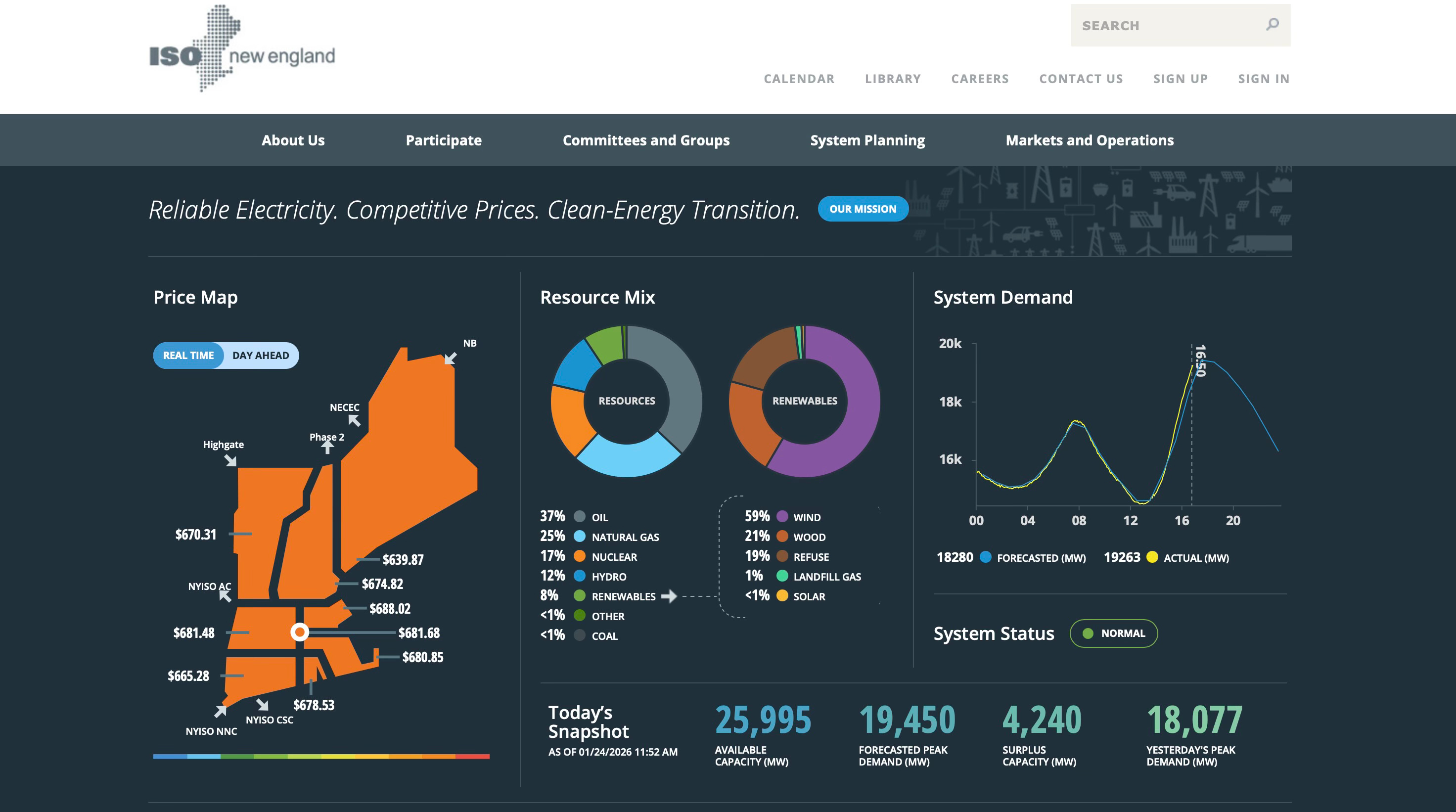
And yet, when I took this screenshot from our grid operator, ISO-NE, around 5 p.m. on January 24, one thing completely surprised me. I was amazed at that arrow on the New England Clean Energy Connect (NECEC) transmission line. The arrow was pointing towards Canada. In other words, New England was exporting to Quebec on that line. Here’s a tweet I wrote. I have added some emphasis.
It’s five pm, my former home town of Wilder VT is 3 degrees. Windchill makes it feel like minus 3. ISO-NE is burning more oil than natural gas. 37% oil, 25% gas. The new NECEC transmission line ?from?Quebec is exporting to Quebec right now.
Looking carefully at the graphic, I see that it is full of surprises .
First, while the wholesale price usually runs between $0 and $100 per MWh, here the price is over $600 dollars.
Second, we usually have NO oil burned on the New England grid. In this snapshot, oil is the dominant fuel (37% oil, 25% natural gas, 17% nuclear, 12% hydro, 8% renewables.)
Third, ISO New England usually imports from Québec and New Brunswick. Net imports are shown on the resource mix circle. Despite the incoming arrows from New Brunswick and New York, we have no net imports on this circle. So, New England was neutral or a net exporter.
Thanks for reading The Electric Grandma! Subscribe for free to receive new posts and support my work.
Same-Old versus Wow
Surprise versus great surprise.
Same-old: the prices on the grid soar during a cold snap. For example, during Winter Storm Uri, ERCOT wholesale prices reached $9000/MWh, compared to pre-storm prices of less than $50/MWh.
Same-old: When natural gas-fired power plants cannot get natural gas (mostly because homes are using it for heating), many of them can burn oil. Oil-fired power at 37% on our grid is unusual, for sure, but not totally unheard of. For example, on January 6, 2018, oil provided 36% of ISO-NE electricity.
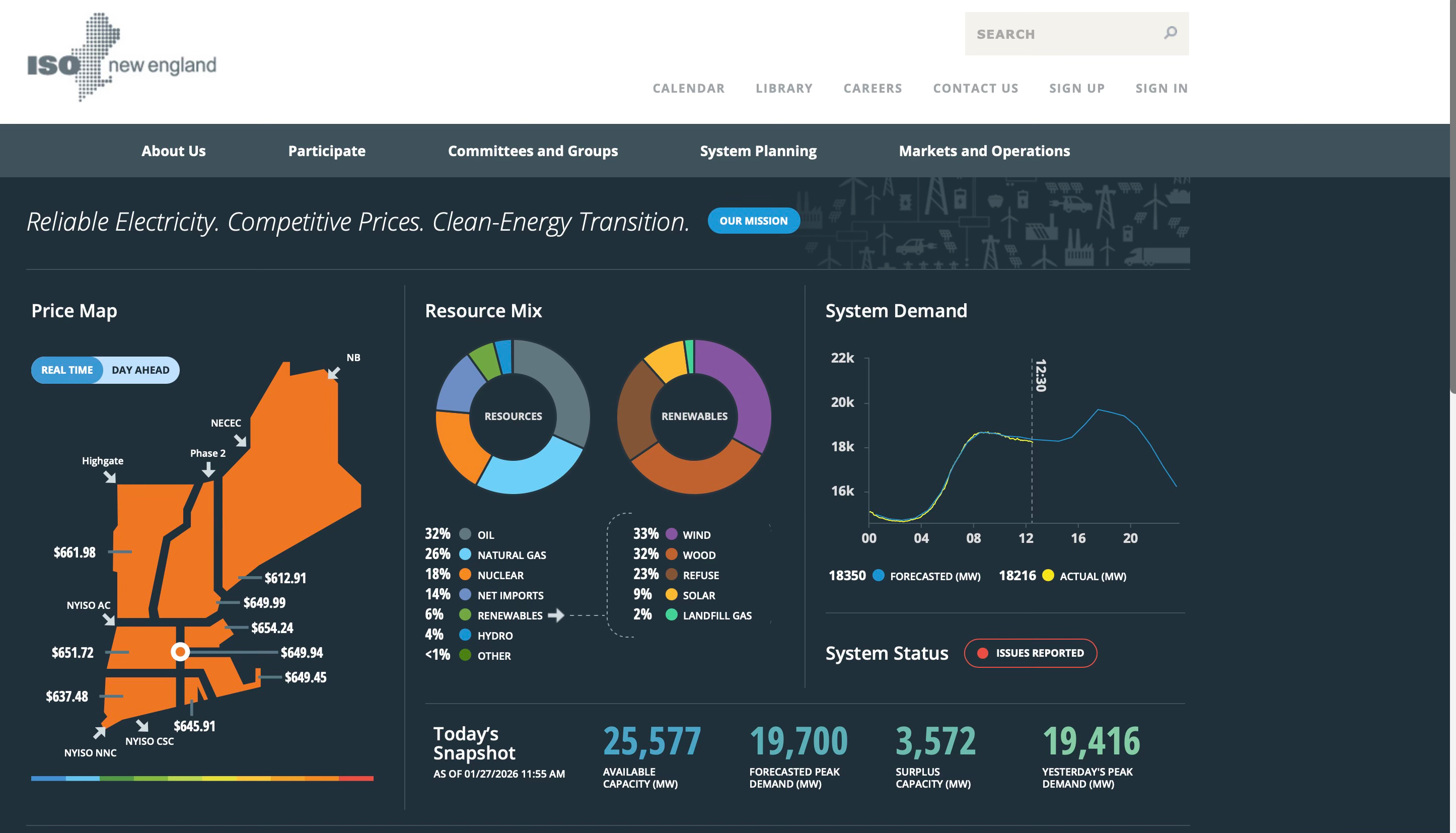
Wow: Even in cold weather, New England tends to import from Canada. For example, right now it is 15 degrees in my old hometown of Wilder VT. Tonight, it will reach minus 6. (This afternoon, I took the screenshot below.) ISO-NE had 32% oil on the New England grid. Lots of oil. But it also had 14% net imports.
Earlier in the month, New England was exporting. That was a great surprise.
What was going on? My first question was to Warren Van Wyck, who maintains a very helpful website for the American grids. https://www.wvwelectric.com/menu/ Many of the graphs on his website are interactive. Van Wyck has a math degree and has worked as a computer programmer. He also served as a representative in the Vermont legislature for several years.
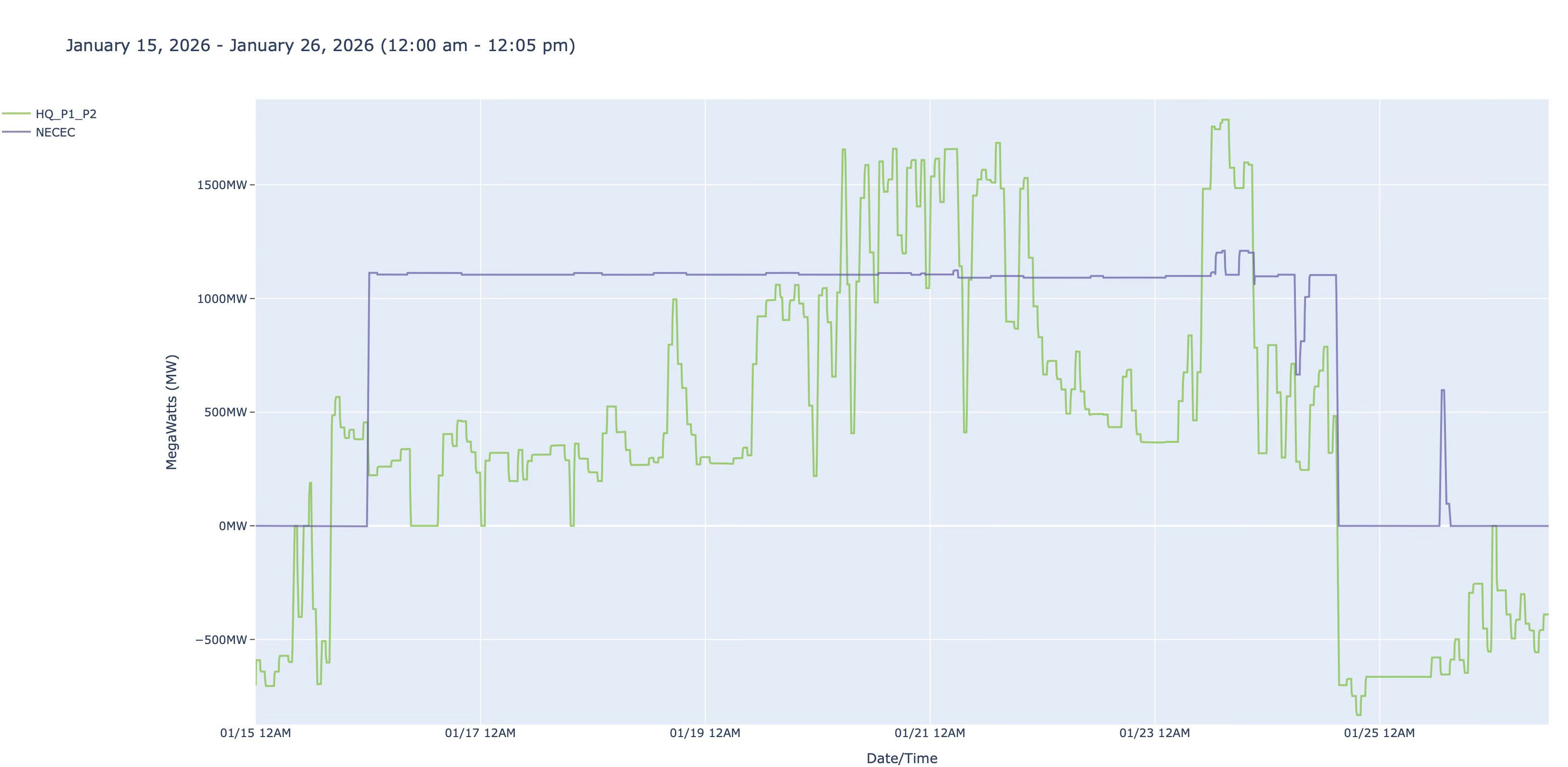
I asked him about this exporting-power business. He was kind enough to make a special-purpose graph for me. Here it is. Positive numbers on this graph show electricity flows to New England. Negative numbers are exports. “Phase 1 and Phase 2” are lines connecting to Québec. NECEC is NECEC, also connecting to Québec.
NECEC (blue line) went into service January 16, and it quickly bought about 1100 MW into New England. Phase 1 and 2 were also sending MW to New England at that time. But….then…on January 25, the cold weather hit. NECEC imports went to zero. The phase 1 and phase 2 lines went negative, which meant New England was exporting to Québec. New England and New York sometimes export to Québec in cold weather. But this situation was particularly dramatic.
A Few Quotes to Contemplate
First, let’s look at a press release from Governor Healey’s office, on January 16 2026.
Governor Healey Celebrates Completion of NECEC Transmission Line
Transmission line will deliver 20% of Massachusetts’ electricity, lower bills by $50 million each year….
During cold temperature periods, New England relies on higher-priced, more carbon-intensive fuels. This leads to expensive and volatile winter energy pricing and regional reliability concerns. The NECEC project will help address these challenges by providing consistent clean energy production during cold temperatures.
“The polar vortex has brought extreme and sustained cold air across Québec,” Serge Abergel, chief operating officer for Hydro-Québec Energy Services, said in a statement.” Later in the article, the author notes that “Hydro-Québec could face significant penalties for falling [sic] to meet the delivery requirements of the contracts.”
Third, I will add my own comment. The NECEC transmission line can deliver 1200 MW. New England shut down two nuclear plants (Vermont Yankee and Pilgrim) in the last ten years. These two plants provided 1300 MW of baseload power to New England.
I miss those plants.
Thanks for reading The Electric Grandma! This post is public so feel free to share it.
Excellent job Meredith. Imagine if VY was online, but no let's make money burn oil, making power, and selling our power, while polluting our beautiful NE.



Excellent job Meredith. Imagine if VY was online, but no let's make money burn oil, making power, and selling our power, while polluting our beautiful NE.
God bless you girl.
I live a mile from Harvard - my utilities bill broke $1k and that was BEFORE the storm.
I miss those nuclear plants too.